

HydroCAD® Stormwater Modeling - Since 1986

|
HydroCAD® Stormwater Modeling - Since 1986
|
|
UNDERSTANDING HYDROLOGY Compiled by Peter Smart Also see the HydroCAD Reference Manual and Self-Training Materials
Copyright © 2004 P.O Box 477 Chocorua, NH 03817 U.S.A. 800-927-RAIN 6166B rev. 8/31/95 Introduction These notes are intended as an outline for the understanding and comparison of various hydrologic methods. They are designed primarily to put the various hydrologic concepts and techniques into proper perspective so that their differences (and similarities) may be better understood. These notes should not be used as the sole basis for applying these techniques. There are many texts available which provide accurate, detailed information on the specifics of each technique. These sources should be consulted before attempting to employ any of these methods. One source that is highly recommended is A Guide to Hydrologic Analysis Using SCS Methods by Richard H. McCuen. Other sources include SCS Technical Release Number 55 (TR-55), and Basic Hydrology by Sharp & Sawden.
The Intensity-Duration-Frequency Relationship
This curve indicates the relationship between the intensity (i) and duration (d) of a rainfall event with a given return period (T). Instead of return period, it is more accurate to think in terms of the exceedance probability (p), where p=1/T. Thus, a "25 year storm" actually designates a rainfall event which has a 4% chance of occurring in any given year.
The Rational Method For Predicting Runoff The Rational method may be used to predict the peak runoff according to the formula: q=CIA q=Peak Runoff [CFS] The method derives its name from the fact that the units have been "rationalized." That is, 1 CFS = 1.01 in-ac/hr. Although the rational method appears straightforward, it is totally dependent on the "correct" selection of C and i: C is based on the soil, ground cover, and other factors. i is obtained from the local IDF curve for a given return period and duration. One of the major challenges of the rational method is choosing the correct duration. The duration must be just long enough for maximum runoff to occur. A longer duration will yield a lower intensity from the IDF curve, and thus a lower runoff. For a single subcatchment the "correct" duration is usually equal to the time-of-concentration. However, when several subcatchments are combined in a complete drainage system the correct duration can have any value between the shortest and longest Tc. The rational method is intended only to determine peak runoff. It does not yield cumulative runoff (volume) and therefore cannot be used when subsequent volume-sensitive routing is required.
The SCS Storm Distributions
These curves were developed from the same depth-duration-frequency data used for IDF curves. Using 30 minute increments, the incremental rainfall was calculated for durations of 30 minutes to 24 hours. For example, the 30 minute depth was subtracted from the one hour depth, and the one hour depth from the 1½ hour depth. Then the largest 30 minute increment was placed at the middle of the hypothetical storm, which is 12 hours. The second largest 30 minute incremental depth is placed in the next 30 minutes, and the third largest in the previous 30 minutes. This process is repeated until the entire 24-hour curve is developed.
The SCS Runoff Equation Studies by the SCS resulted in the following empirical relationship for runoff: (P-.2S)²
1000 Q=Precipitation excess (runoff) [inches] In other words, given the Curve Number and Cumulative precipitation at any point in time, we know the volume of the resulting runoff. However, we don't know when the runoff will occur. Note: The Curve Number is based on the soil type, ground cover, and other factors. The determination of the CN is a separate topic which will not be covered here. Suffice to say that high curve numbers (up to 100) indicate complete runoff with little retention, and low numbers indicate high retention and reduced runoff. The CN is the rough equivalent of the C-value used in the Rational method.
Determining The Time-Of-Concentration To determine how the runoff is distributed over time we must introduce a time-dependent factor. The time-of-concentration, or Tc, is utilized for SCS methods. The Tc is most often defined as the time required for a particle of water to travel from the most hydrologically remote point in the watershed to the point of collection. There are several methods available for calculating Tc, one of which is the Lag Method:
L
l^.8 (S+1)^.7
1000 TC=Time of
concentration [hours] Other methods in common use include:
All of these techniques are provided by HydroCAD. This allows selection of the method(s) best suited to each situation.
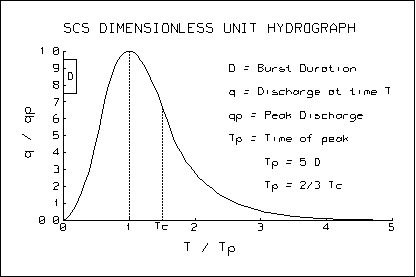
The SCS Dimensionless Unit Hydrograph A unit hydrograph represents the runoff resulting from: * One inch of precipitation excess, The hydrograph is made dimensionless by expressing: * Ordinates as a fraction of the peak discharge qp, By analyzing a large amount of measured data the SCS developed an average dimensionless unit hydrograph:
To dimension the time axis of the UH we use the following relationships: Tp = 5 D and Tp = 2/3 Tc therefore D = Tc / 7.5 Tp=Time to peak [hours] This allows the burst duration D, and the overall duration of the UH, to be determined based solely on the time of concentration. To dimension the ordinates of the UH we can use the following relationship between the volume and peak of the UH: qp = 484 A Q / Tp = 726 A Q / Tc qp=Peak discharge [CFS] This allows the ordinates of the UH to be dimensioned based on the precipitation excess (Q), as previously determined by the SCS runoff equation.
Convolution: The Heart of TR-20 The unit hydrograph, when dimensioned, tells us what the runoff will be for a single burst of rainfall. To determine the runoff for the entire storm, we must perform a convolution of the unit hydrograph with the precipitation excess. This is simply a summation of many unit hydrographs, each of which represents one burst of runoff. The process is as follows: 1) For the first burst (of duration D) we determine the precipitation excess and create a corresponding Unit Hydrograph. 2) For the next burst we determine the precipitation excess occurring during the interval D which is Q=Q(t+D)-Q(t). We create the corresponding UH, translate it by the duration D, and add it to the previous result. 3) Step 2 is repeated for all durations D needed to compose the entire 24-hour storm. The resulting hydrograph represents the runoff from the entire storm. This is the fundamental method used by TR-20 for predicting runoff. Note that if Tc=7.5 minutes, D=1 minute, and a 24-hour storm will consist of 1440 bursts generating an equal number of unit hydrographs. If the UH consists of 100 coordinates, about 140,000 coordinates must be summed to produce the composite hydrograph! Obviously, such a technique cannot be performed by hand.
TR-55 & The Tabular Method Because of the enormous computational requirements of TR-20, the SCS derived the simplified tabular method as the basis for TR-55. The tabular method consists of a number of composite hydrographs produced with TR-20 which are then scaled and interpolated in order to approximate the results which would have been produced with TR-20 itself. In order to keep the number of tables to a minimum, average values had to be used for various variables. The equations of TR-55 were then designed to re-introduce the dependencies on these parameters. The two primary assumptions of TR-55 are a Curve Number of 75 and a runoff of 3 inches. TR-20 and TR-55 can be expected to deviate as these assumptions become invalid. A number of other conditions also indicate the use of TR-20:
The approximations of TR-55 are sufficient to cause the SCS to place the following warnings in the documentation:
This applies particularly to the design of detention basins which are very sensitive to changes in the inflow hydrograph. Again quoting from TR-55:
When evaluating TR-55, keep in mind that it was developed solely for manual use. When computers are available the original TR-20 methodology would appear to be preferred For further information please see the HydroCAD Reference Manual |
|
 Based on
rainfall observations, IDF curves can be compiled for any location:
Based on
rainfall observations, IDF curves can be compiled for any location: By studying the Weather Bureau's Rainfall Frequency Atlases, the Soil
Conservation Service determined that the entire country could be represented by just four dimensionless
rainfall distributions of 24-hour duration. Each distribution is expressed as a mass
curve indicating what fraction of the total 24-hour precipitation has fallen at
any time.
By studying the Weather Bureau's Rainfall Frequency Atlases, the Soil
Conservation Service determined that the entire country could be represented by just four dimensionless
rainfall distributions of 24-hour duration. Each distribution is expressed as a mass
curve indicating what fraction of the total 24-hour precipitation has fallen at
any time.